
How to Protest Business Property Tax in Texas (over 20K tax saving)
How to Protest Business Property Tax in Texas (over 20K tax saving)
I’m sharing a real-life case where I successfully helped a client reduce their property tax valuation from $2.6 million down to $1.45 million, resulting in $20,000 in tax savings. Contact us today if you have similar concerns!
TAX KNOWLEDGE
Zlin CPA
7/3/20255 min read
Introduction
In this blog, I’m sharing a real-life case where I successfully helped a client reduce their property tax valuation from $2.6 million down to $1.45 million, resulting in $19,000 in tax savings for 2025. The local appraisal district had given an absurdly high valuation — off by $1.2 million — so the client came to me for help.
Most property tax protest firms on the market charge around 40% of the tax savings as commission, or a $1,000 base fee plus 25% commission. And honestly, most of them just go through the motions — maybe have a quick chat with the appraisal office, help you save a few thousand, and then bill you $1,000 to $2,000. They don’t really care about the actual condition or value of your property.
Since I already handle this client’s bookkeeping and taxes, I knew their commercial real estate financials inside and out. I was so furious about the $2.6M valuation that I took on the case myself and agreed to only charge 10% of the tax savings as my fee.
Step 1: Filing the Protest
Submit a Notice of Protest
-
Starting in April, you’ll usually receive your property value notice from the local appraisal district. Make sure to save the PIN number on that notice — you’ll need it later.
-
The protest deadline is typically May 15. You can file by mail or electronically on the appraisal district’s website.
-
When selecting the reason for your protest, check either or both of:
-
“Incorrect Market Value”
-
“Value unequal compared with similar properties”
-
-
You can also enter what you think the correct value should be and choose how you want to attend the hearing (in person, phone, video call, or by agent).
Step 2: Getting Ready for the Hearing
You’ll usually receive a Hearing Notice within 30 days of filing your protest. That notice includes the date and time of your formal hearing.
⚠️ Important: You must attend the hearing. If you miss it, you waive your right to further protest.
Gather Your Evidence
To prove your property’s value is lower than what the appraisal district claims, there are three commonly used methods:
-
Sales Comparison Approach: Find recent sales (preferably within the last 12 months) of similar commercial properties in the area.
-
Income Approach: If the property generates rental income, use the Net Operating Income (NOI) to calculate value based on a capitalization rate.
-
Cost Approach: Use the estimated replacement cost minus depreciation. This is mostly used for new or special-purpose properties.
Informal Negotiation
-
At this stage, someone from the appraisal district may reach out via phone or email to negotiate a new value.
-
The proposed value will likely be lower than the original — but whether it’s acceptable depends on your situation.
-
In our case, they offered to lower it to $2.4 million, which was still ridiculous — basically a copy-paste low-effort offer.
-
I declined the offer and prepared for the formal hearing.
Preparing Evidence for the Hearing
Since I also manage the client’s annual financials and tax filings, I decided to go with the Income Approach this year.
For income-producing commercial properties, you’ll need:
-
Rental agreements
-
Rent roll
-
Cap rate (Capitalization Rate)
-
Profit & Loss statement
-
⚠️ Important: Clearly separate operating expenses from non-operating expenses — the valuation relies on Net Operating Income (NOI).
Submitting Evidence Early
-
Ideally, submit your documents at least 15 days before the hearing.
-
You can upload them online (use your PIN to create a property account).
-
You may also hand-deliver the documents to the appraisal office.
Step 3: The Hearing Day
Be Ready with Your Documents
-
Bring four copies of all your protest documents, and two copies of any photo evidence.
-
Three sets will be used; the fourth is a backup.
-
Don’t forget to bring your Hearing Notice — staff will scan the barcode when you check in.
-
If you have any last-minute documents, you can bring those too — they’ll scan and enter them into your file.
Arriving at the Appraisal Office
-
You’ll see armed security officers at the building, but don’t worry — they’re actually very nice. Feel free to ask them for help if you’re lost.
-
Go to the check-in desk and hand them your hearing notice so they can scan the barcode.
-
You’ll be given a number slip — then just wait until your number is called.
Pre-Hearing Conference
-
A staff member will meet with you to review your documents and see if anything is missing.
-
They may also try a second round of informal negotiation to settle without a formal hearing.
-
Don’t get nervous. If they’re pushing for a deal, it means they’re unsure and don’t want to face you in front of the panel — this is your advantage. Stick with it and go into the formal hearing.
The Formal Hearing
Who’s in the room:
-
1–2 ARB panel members (Appraisal Review Board) — think of them as judges. They’ll make the final decision. Ours was a kind older gentleman.
-
1–2 representatives from the appraisal district — like the defense lawyers.
-
And then there’s me, representing the property owner (like the plaintiff’s attorney).
Tips:
-
Be friendly. The ARB panel will decide your case — win their favor.
-
Also, treat the appraisal reps politely. They’re just employees doing their jobs, and if they like you, they may go easier or even tip you off during the hearing.
What happens:
-
The entire hearing is recorded.
-
Everyone is sworn in under oath — just like in a courtroom.
-
Each side presents their case and evidence.
-
I always suggest letting the appraisal reps speak first. This gives you a chance to hear their logic and poke holes in it.
-
When it’s your turn, you have five minutes to speak. Take your time. When referring to a document, pause to hand it over to the ARB panel and let them review it slowly.
Rebuttal Phase
-
After initial presentations, the appraisal reps give a rebuttal — they may tweak their valuation.
-
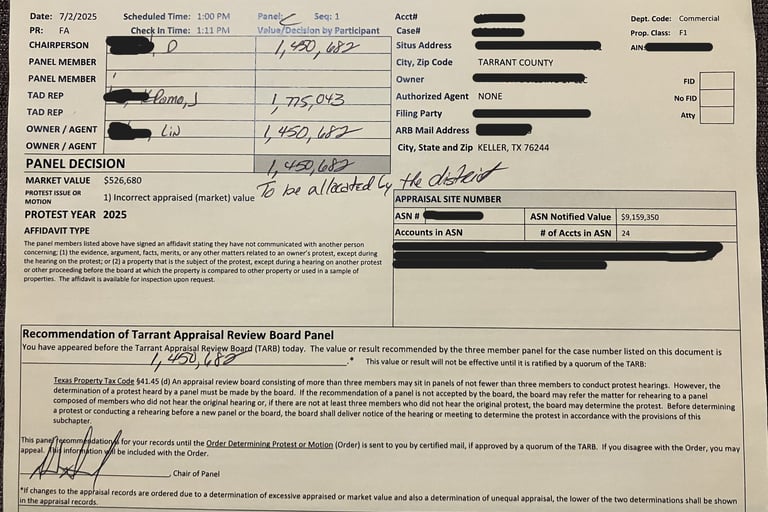
In our case, they revised their estimate down to $1.7 million based on my evidence.
-
Key Tip: Listen closely — look for weak points in their logic and methodology.
-
When it’s your turn, rebut their assumptions with facts, especially where their numbers don’t match your real-world data.
Decision Phase
-
Once both sides finish, the ARB panel starts calculating based on the evidence.
-
The panelist will likely take 5–10 minutes punching numbers into a calculator, based on a method they’ve already decided is fair.
-
Final Decision: They announce their ruling. If either side disagrees, there’s still the option to appeal.
✅ In our case:
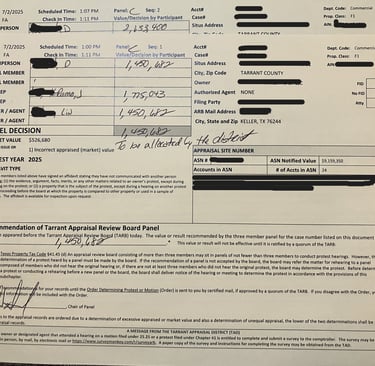
The panel completely sided with me. They accepted my valuation and lowered the assessed value from $2.6 million down to $1.45 million. Total win.
Final Thoughts
I learned a ton through this protest process and wanted to share it with others. There are so many overpriced, low-effort services out there charging outrageous fees (seriously, 40% commission??). I can’t help but wonder — does charging such a high rate mean they don’t expect to save you much to begin with?
Our client had organized and professional financial records, thanks to our accounting services. That full documentation was a key factor in our success. So if you’re serious about saving on property taxes, make sure your financials are rock-solid, and don’t be afraid to fight back.